Industries · Food & beverage

Industries · Food & beverage

95% of F&B innovations fail. Build the right thing with The BOX.

The BOX brings together market data, consumer intelligence and your internal constraints (lines, ingredients, suppliers, regulation) to surface opportunities, generate ideas, and help you test them and bring them to shelf. From brief to validated F&B concept in weeks.

Book a demo
Coffee beans and ground coffee, food & beverage R&D
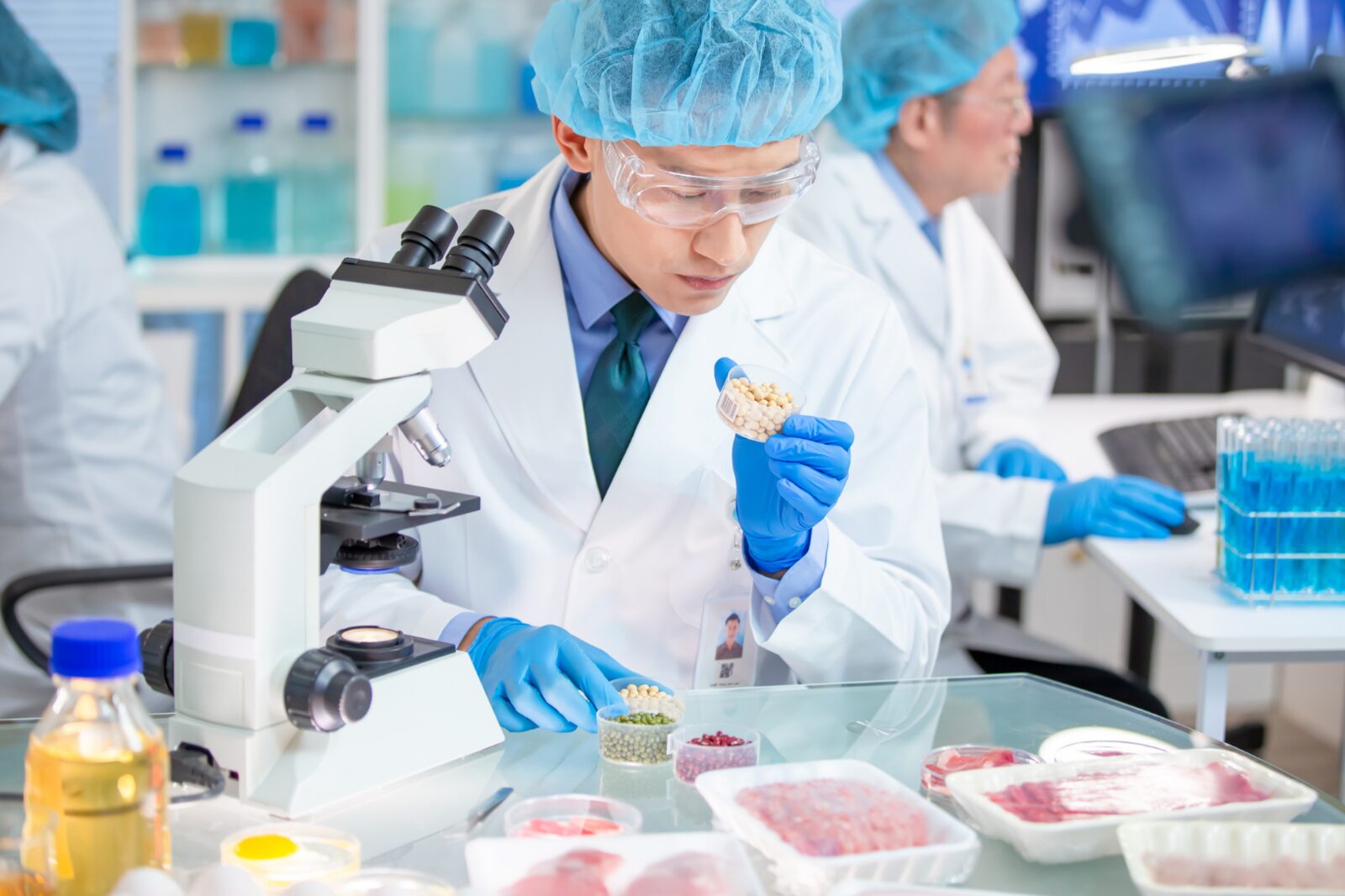
Food scientists inspecting samples in a food R&D lab

What we hear

Food and beverage teams struggle with

1.

Working on the right projects

We have more ideas than capacity. The ones that get funded are not always the ones that should.
2.

Long time to market

By the time a concept clears internal review, the market window has already shifted.
3.

Collaboration and knowledge sharing

Every team is working hard. Almost none of them are working from the same information.

One example, end to end

The BOX gives you signal-to-shelf innovation

How one coffee team went from three loose signals to a validated multipack. Scroll to follow it.

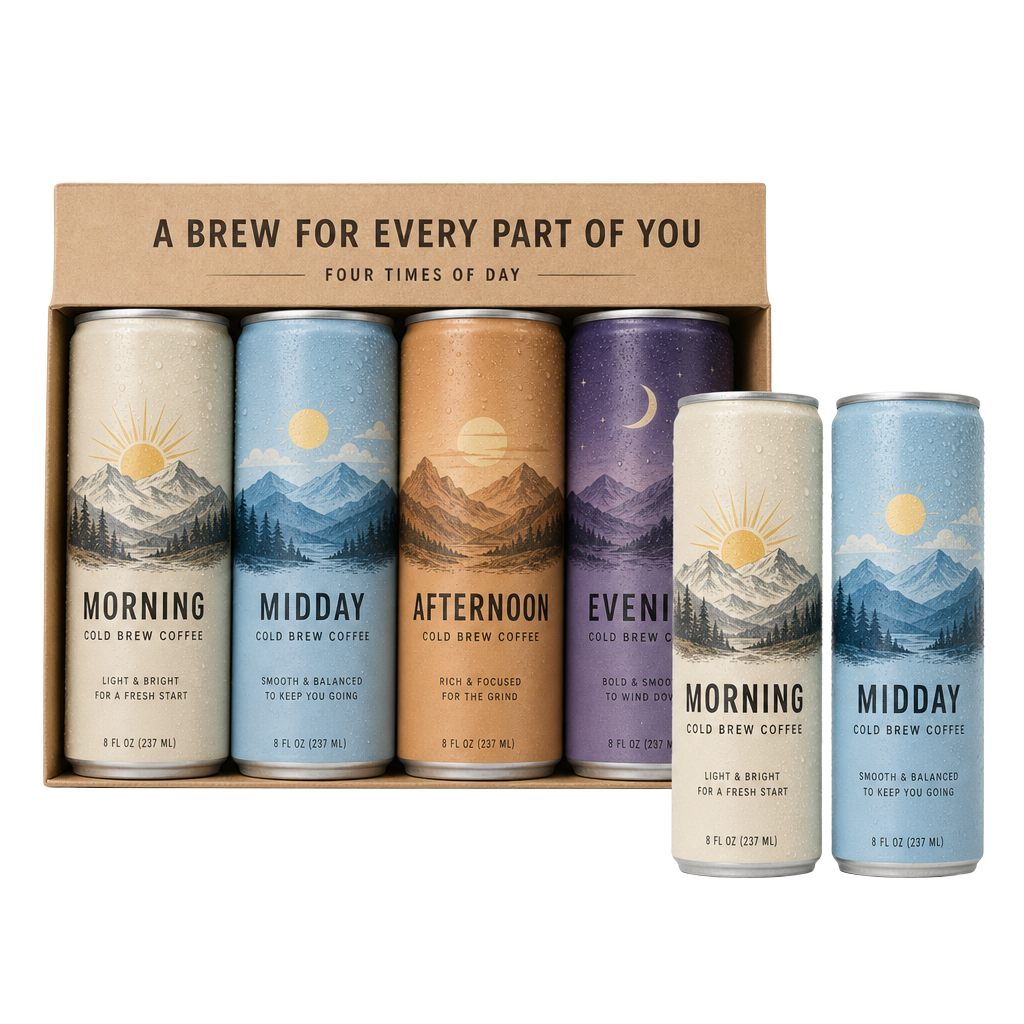
Ready-to-drink cold brew multipack concept: one brew for every part of the day
1
Radar opportunity map
The RADAR

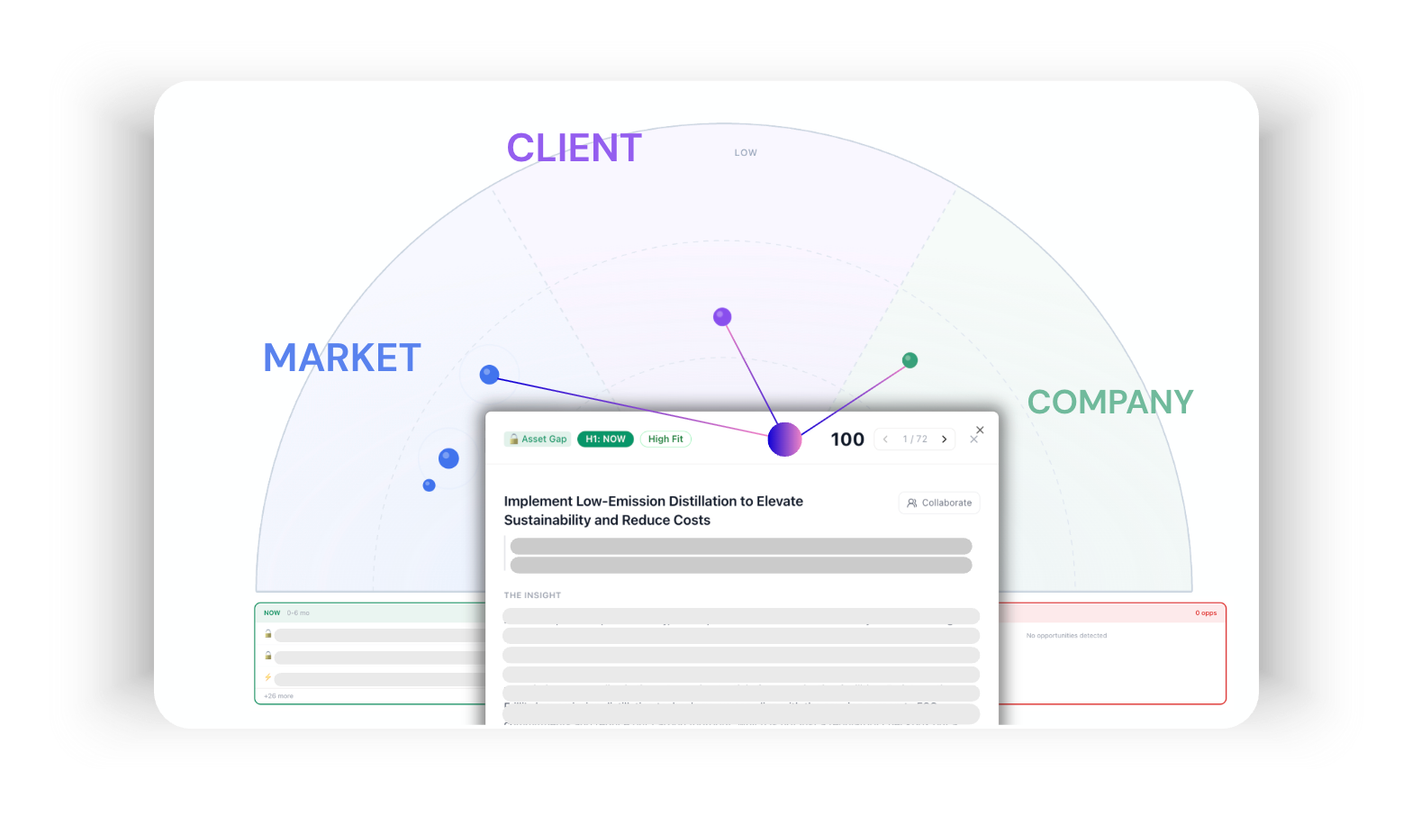
spotted the opportunity where three signals met: functional coffee + seasons, a retail client request and our Nashville line running under capacity.

2
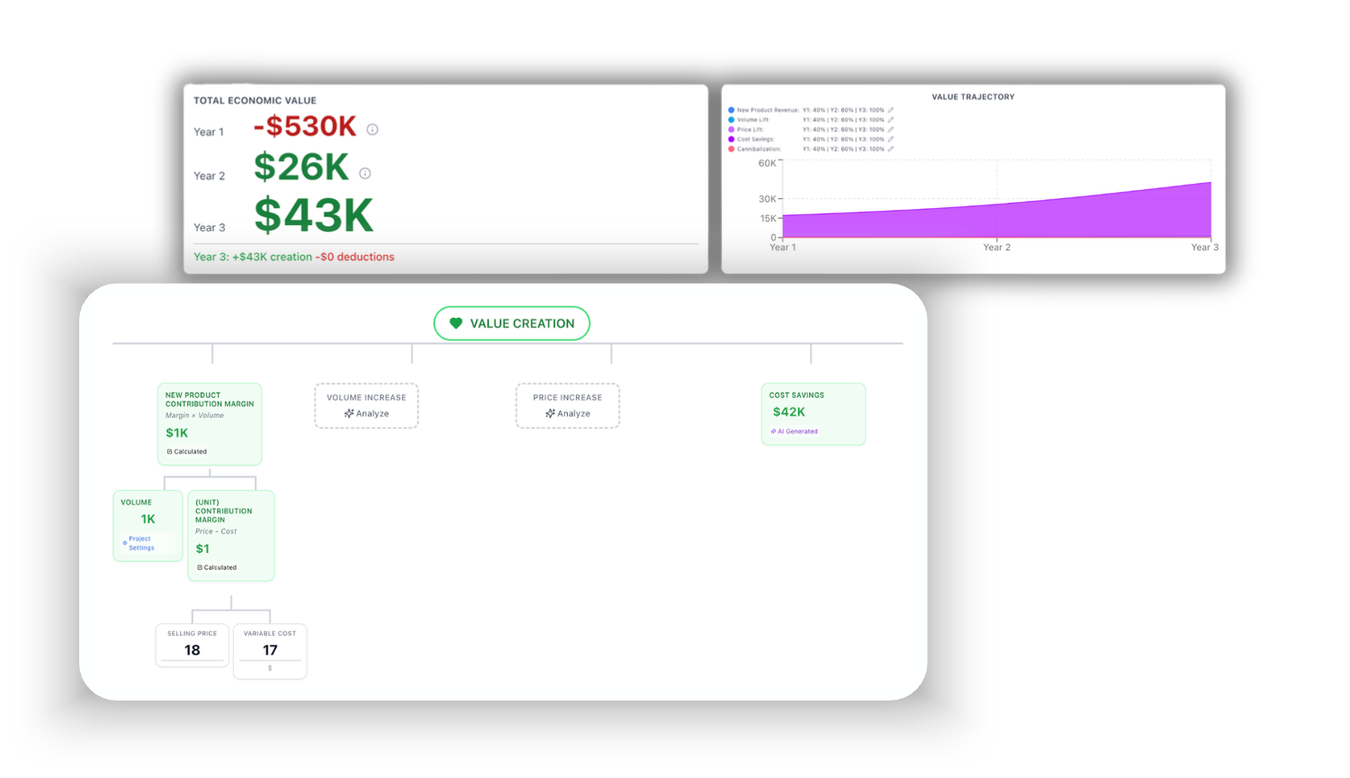
Business case figures
The STUDIO

made it concrete: zeroed in on the recipe and ran a preliminary business case.

3
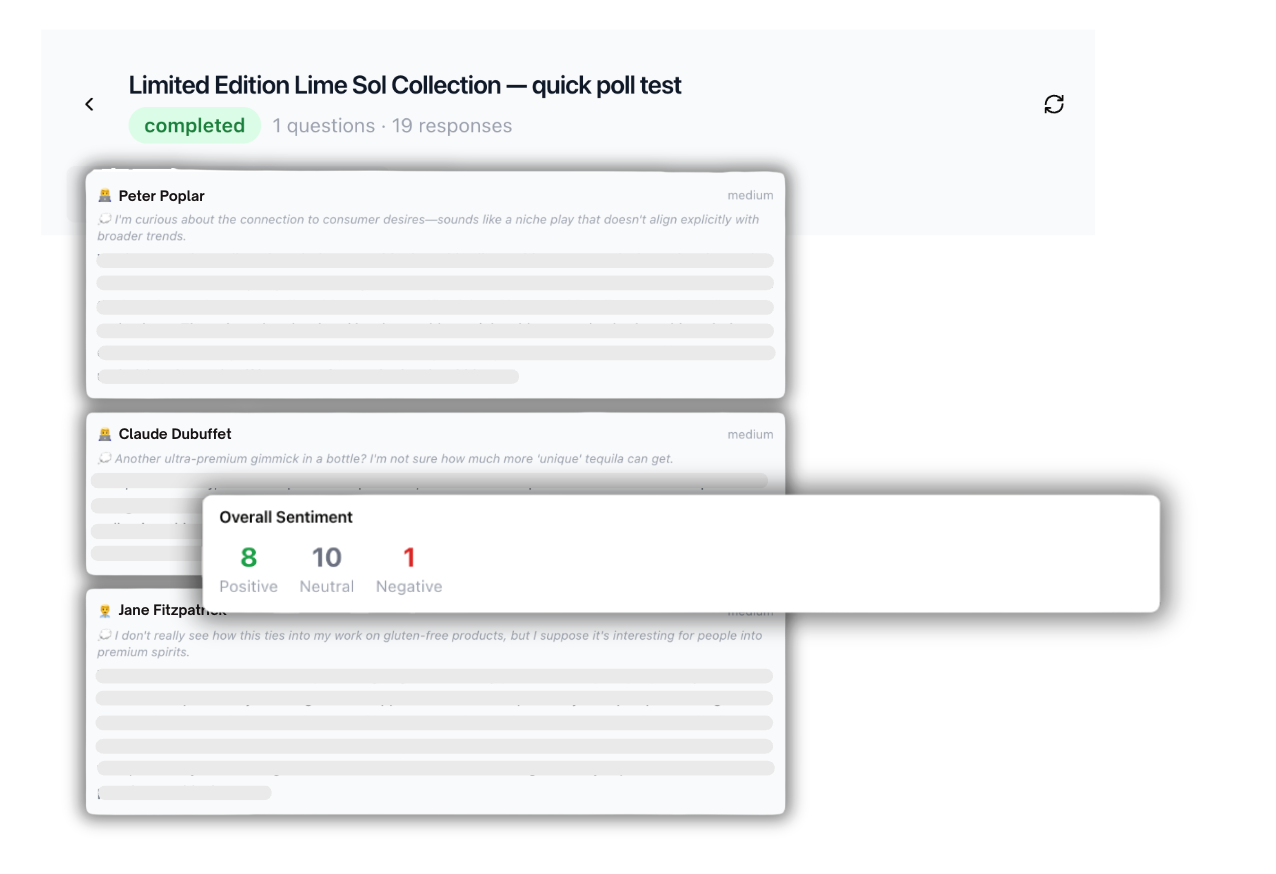
Digital twin panel results
The MIRROR

tested the concept with a panel of 70 digital twins of real-world consumers.

4
The PIPELINE

retro-planned towards go-to-market and coordinated R&D, supply and marketing.

Result

A four-SKU cold brew multipack, one brew for every part of the day. Concept to validated business case in weeks.

How it works

Your next product should be born from your constraints. Not killed by them.

Four modules, built for F&B. The same platform our coffee, confectionery and bakery clients run on, with the examples they actually use.

Module 01 · Map + Monitor
01 — Always-on radar

Opportunities surface before you brief anyone.

The radar scans market, consumer and internal signals around the clock and flags where they intersect: a trend, a client ask and a line with spare capacity.

  • Asset gap 65% utilisation at the Nashville tortilla line
  • Market white space premium baked goods +25%, repeat rates 2.4x on artisan
  • Opportunity a premium, fibre-rich tortilla range on the underused line
Radar opportunity map
Module 02 · Drive + Develop
02 — Food science & regulatory

Formulation and compliance direction in minutes.

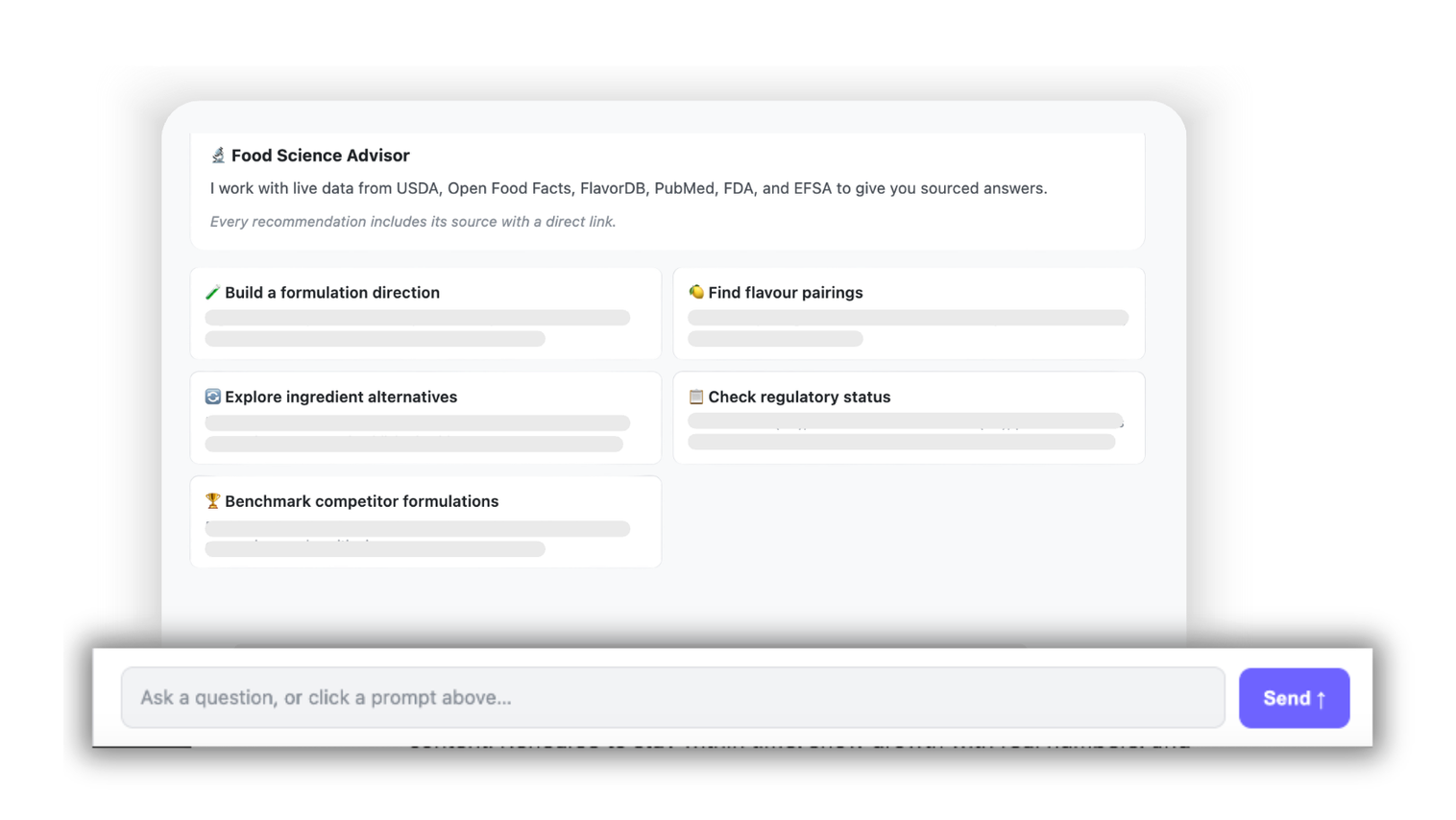
A Food Science agent grounded in 16 databases (USDA, Open Food Facts, FlavorDB, PubMed, FDA, EFSA) drafts a formulation direction, checks regulatory status and pairs flavours.

  • Formulation whole wheat flour 55–65%, wheat or oat fibre 3–8%, resistant starch 3–8%
  • Regulatory ingredients clear GRAS; allergen labelling flagged
  • Claims which fibre claims the recipe can legally carry
Free, no setup. Ask it a real formulation question.
Food Science agent
Module 02 · Drive + Develop
03 — Business case & prioritisation

Every concept comes with its business case.

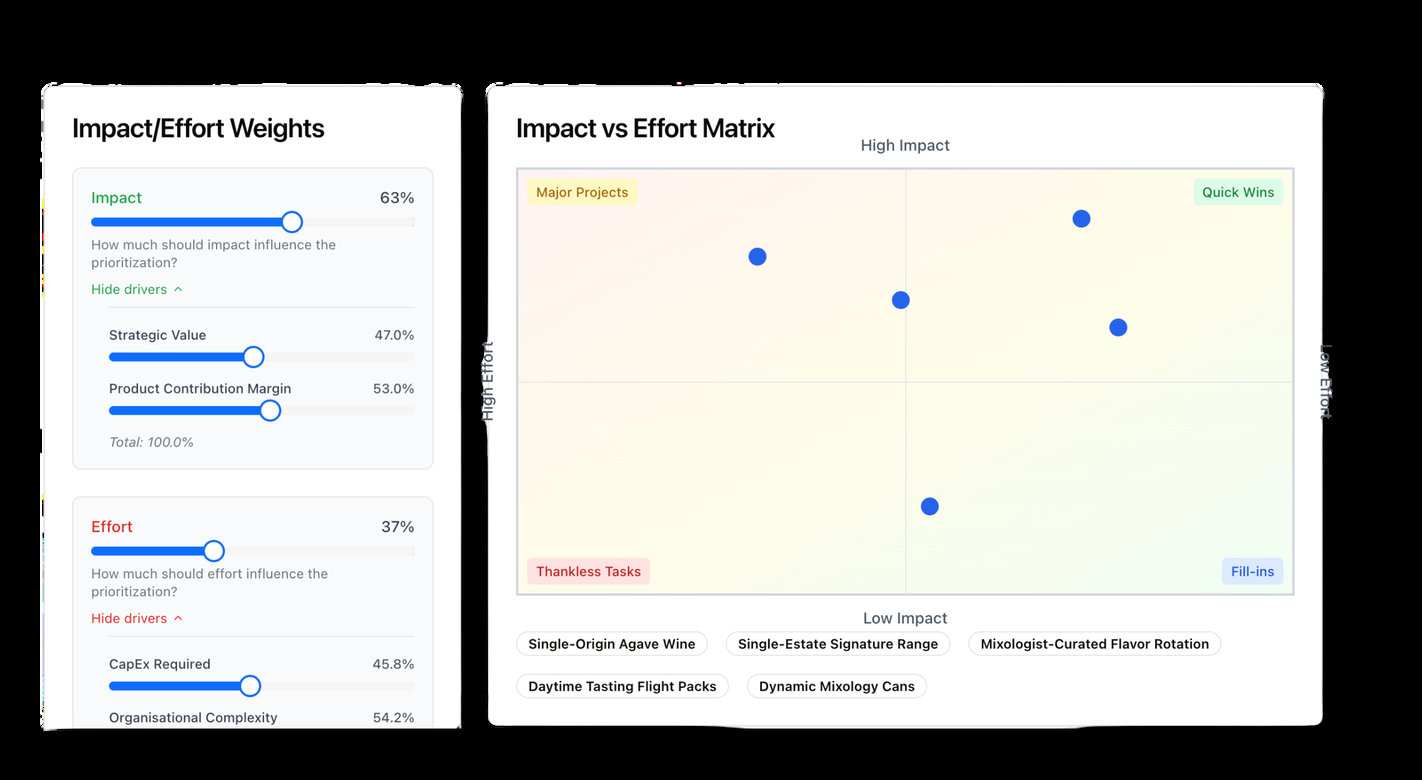
A preliminary business case per idea plus impact-vs-effort scoring, so the portfolio is prioritised on numbers instead of the loudest voice in the room.

  • Total economic value USD 15M by year 3
  • Capex USD 8M on the existing line
  • Verdict quick win in the portfolio
Business case figuresImpact vs effort matrix
Module 03 · Prototype + Prove
04 — Digital twins

Test with consumers and buyers before the real study.

Panels of digital twins built from your own research data react to concept, claims and price in hours, so you iterate before paying for a field study.

  • Consumers 80% positive on the tortilla concept
  • Retail buyers 60% positive; range and price concerns surfaced early
  • Cold brew multipack validated with a 70-twin panel
Digital twin panel results
Module 04 · Execute + Track
05 — Collaboration & pipeline

One thread from signal to shelf, humans in the loop.

Edit any agent's work, pull in R&D, supply and marketing, talk to suppliers, and retro-plan the launch from the shelf date backwards.

  • Internal “@Carlos, can we use a cheaper ingredient? We’re trying to take 10–20c out of unit cost.”
  • Suppliers “Hi Jane, we’re looking for pyramid-shaped cans, is this something you can provide?”
  • Retro-plan GTM milestones, owners and approvals in one place
C
@Carlos can we use a cheaper ingredient? We are trying to reduce unit cost by 10–20c.
J
Hi Jane, we are looking for pyramid-shaped cans, is this something you can provide?

F&B use cases

Real challenges from innovation, R&D and NPD leaders

01

VP Innovation — European F&B company

Result

47 constraint-aware concepts generated in 3 hours. 6 moved to R&D validation.

Human at the centre

The hardest thing about AI is people

Most AI-for-innovation projects fail on adoption, not technology. We pair AI with a real understanding of how food and beverage teams actually work, with R&D, marketing and operations pulling in different directions. The BOX keeps your people in control: agents do the heavy lifting, your team keeps the judgment. The leverage is ours; the decisions stay yours.

Humagentic: food scientists and AI agents side by side.
Enterprise-grade from day one.Your recipes and data stay yours, and we never train anyone else's model on them.
ISO 27001ISO 27001:2022Information security
AICPA SOC 2SOC 2 Type IISecurity & availability
GDPRGDPREU data protection

Proof

A top coffee company runs its opportunity scouting and ideation on The BOX. A heritage Italian confectionery house went live on a full-year deployment.

See customer stories →

Questions

Can AI actually help with reformulation?

Yes, when it knows your constraints. The BOX runs reformulation against your production capabilities, cost targets and label rules, so suggestions are buildable, not generic ingredient swaps.

What exactly does the Food Science Agent do?

It gives innovation and R&D teams instant, sourced answers to the food science questions that normally take days of desk research. It pulls from USDA nutritional data, 2 million+ real product formulations on Open Food Facts, 225K flavour molecules from FlavorDB, published evidence from PubMed and regulatory databases from the EU, US and UK. It does six things: builds formulation directions for new concepts, finds molecular flavour pairings, identifies ingredient alternatives with trade-offs, checks regulatory status across jurisdictions, benchmarks competitor formulations and finds cheaper ingredient options with relative pricing. Every answer cites its source with a direct link.

What kinds of formulation questions can it answer?

Anything from “what ingredient base would work for an ambient plant-based protein shake at 20g per serving” to “what emulsifier options exist for an acidic beverage below pH 4.2”. Every recommendation is anchored to named products already on shelf, and it flags key challenges up front: if pea protein creates haze above 5% and your concept needs clarity, it tells you before your R&D team finds out in the lab. We call these formulation directions rather than formulations: a head start for your food scientists, not a replacement for lab work.

How does it handle regulatory considerations across markets?

It checks structured databases from the EU (food additives, flavourings, health claims, novel foods), the US (FDA GRAS status) and the UK (FSA post-Brexit data), and returns the exact authorised claim wording you can put on a label, with conditions of use. It also runs a horizon scan via EFSA opinions and the FDA Federal Register to flag upcoming changes. For markets without structured databases (Japan, Australia, GCC), it is transparent about the gap: it shows what it knows from EU/US/UK, searches the specific market’s requirements and flags that web-sourced data needs verification with a local regulatory consultant.

Does it have depth in coffee and specialty ingredients?

Yes. The FooDB database behind the agent holds 70,000+ food compounds with health effects and food source mapping, which gives it strong coverage of coffee, functional botanicals, adaptogens and novel proteins. For coffee specifically it can pull compound-level data on chlorogenic acids, caffeoylquinic acids, trigonelline and other bioactives. It is most powerful combined with your own knowledge: your approved ingredients, supplier relationships and proprietary formulations sit alongside the public databases.

How does the Food Science Agent work alongside our food scientists?

It handles the desk research so they don’t have to. When a food scientist gets a brief for a new plant-based RTD, they currently spend days pulling competitor ingredient lists, checking regulatory status across markets, reviewing stability and shelf-life literature and mapping formulation paths. The agent does that in minutes. Your scientists review the direction, apply their judgement and take the concept into the lab. Every output is framed as a formulation direction with a clear note that lab validation is required, so your scientists spend more time on formulation, sensory testing and scale-up.

Can it work within our specific production constraints?

Yes. When you set up a project in The BOX you define your constraints: production lines, equipment, certifications (organic, kosher, halal, BRC), target markets, margin requirements, allergen restrictions and existing supplier relationships. If you ask for alternatives to acacia gum and you have a “no new vendor onboarding” constraint with Kerry Group as an existing supplier, the agent flags which alternatives Kerry can supply and which would need a new vendor. Every recommendation is marked compatible, partially compatible or blocked by a specific constraint.

How current is the Food Science Agent’s knowledge?

The structured regulatory databases (EU additives, EFSA health claims, FDA GRAS, UK FSA, Novel Foods) are refreshed monthly from the official EU DG SANTE API and other government sources. Open Food Facts updates continuously; FlavorDB and FooDB update periodically. For anything fast-moving, such as a recent EFSA re-evaluation or a new US state-level ingredient ban, the agent searches live sources (EFSA, FDA Federal Register, Food Navigator) and flags recency and confidence. You always see whether an answer comes from an official database (high confidence) or a live web search (medium confidence, verify independently).

How is this different from PLM like Trace One?

PLM manages formulations and compliance. The BOX handles the front end of food product development: spotting opportunities, developing and proving concepts, then hands off to your PLM.

SaaS or custom?

Both. Go live in days on configurable SaaS, or have modules custom-built around your process and stack. Deployment includes training and coaching.

Do we need our own data to start?

The more of your constraints and past work The BOX has, the sharper it is. Most teams start with what they have and enrich as they go.

Is our data secure?

Yes. ISO 27001:2022 and SOC 2 Type II assured, GDPR-compliant, hosted in the EU.

See your next product in weeks, not months.

Book a 30-minute demo with a real F&B challenge and we’ll show you what The BOX finds. Or start now: the food science agent is free to try.

Book a demo